
Week two of our Musician Spotlight Series!
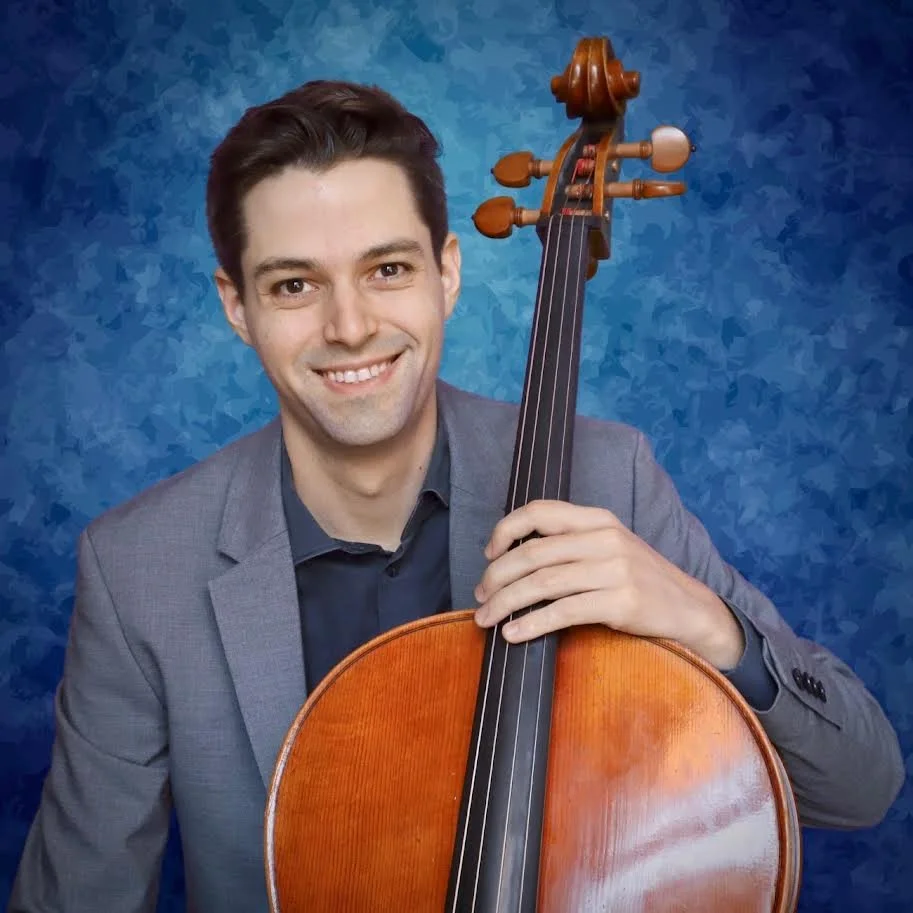
We're excited to introduce our next featured musician in Symphony North of Houston's Behind the Stand series: Graeme Richmond, Principal Cellist!
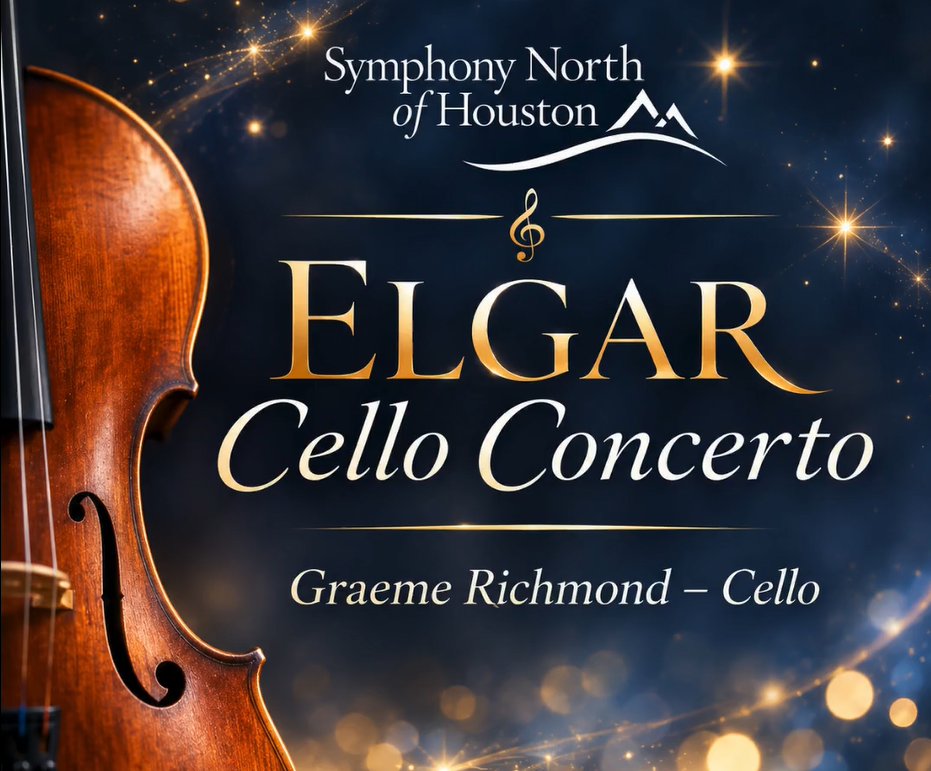
Graeme is an exceptionally talented musician and educator who previously captivated our audience with his performance of Elgar's Cello Concerto.
Join us as we get to know the musician behind the music! Graeme shares his musical journey, his experiences as Principal Cellist, and a glimpse into his life beyond the concert stage.
We hope you enjoy getting to know another wonderful member of our Symphony North family!
Graeme Richmond, Principal Cellist
SN: How did your musical journey begin? What first drew you to the cello, and when did you realize it was something you wanted to pursue?
Graeme: My musical journey began before I can remember! Both of my parents are retired collegiate music professors, and I was surrounded by classical music from before I was born. I grew up doing Kindermusik and singing in children's choirs, and at age 7 my parents asked me to choose an instrument to play. I decided on the Cello because it has such a large range of deep, low sounds as well as soaring, beautiful high sounds (but also because it was the only instrument that you got to play sitting down at all times!). The more I played it, the more I fell in love with it, and to this day I wouldn't change that choice for any other instrument in the world!
SN: What do you love most about the cello?
Graeme: I love how versatile it is! It's the closest range that any instrument has to the human voice, and I truly believe that it can capture any emotion that the player chooses to express.
SN: As principal cellist of Symphony North of Houston, what does your role involve beyond playing your own part? What responsibilities might surprise someone in the audience?
Graeme: Besides playing my cello, I listen to auditions for the cello section and decide chair placement, I create the bowings (when we change bow directions) for every piece we play, and I put up concert posters in my school so that as many people as possible can come enjoy the amazing, free performances that we create together!
SN: Last season, you performed Elgar's Cello Concerto with Symphony North of Houston. It's such an emotionally powerful and beloved work. What was that experience like for you, and what made it particularly special?
Graeme: The Elgar Cello Concerto has always been my favorite cello piece. In 5th grade, I would put on Jacqueline du Pré's recording every night when I went to bed, and ever since then it was a dream of mine to perform it with an orchestra. In college, I auditioned for the yearly concerto competition twice with the Elgar, and although I made it to the finals my Junior year, I never got to perform the piece with the Orchestra. When Karl approached me about performing a piece with Symphony North, I didn't even hesitate with my choice! Performing it with Symphony North was an absolute joy, and I couldn't be more grateful for everyone involved for the opportunity.
SN: Elgar's Cello Concerto is considered one of the great masterpieces of the cello repertoire. What makes this concerto so special to cellists, and what makes it particularly challenging to perform?
Graeme: Although there are many incredible pieces that have been written for the cello, the Elgar Cello concerto captures a melancholy that I don't think I've ever felt while listening to or playing any other piece of music. It seamlessly weaves so many complex emotions and musical themes together into a tapestry that feels somehow greater than the sum of its parts. The 4th movement in particular takes musical themes and ideas from throughout the other three movements, and ends in a restatement of the first motif of the concerto, coming full circle and ending with a bombastic punctuation that ties the entire concerto together. The second movement is particularly challenging because it spans the entire range of the cello, traveling into three different clefs, all while using the incredibly challenging sautille bow stroke at a breakneck pace.
SN: In addition to performing, you're also involved in music education. Can you tell us about your teaching career and what you find most rewarding about working with young musicians?
Graeme: As I previously mentioned, both of my parents are retired collegiate music educators, so I have always been surrounded by a love of both music and musical learning. Although I began my college career as a Music Performance major, I quickly realized how much I loved teaching others, and I pivoted as a Sophomore to the Music Education track. My first year out of college, I served as a clinician to local schools in west Michigan, and then in the summer of 2018, I applied for my first teaching position at Woodridge Forest Middle School, and moved to Texas when I was offered the position. I spent 7 years there, and recently moved to West Fork High School, where I continue to teach the same students that I started in 6th grade! The most rewarding part of teaching is seeing all of my students grow from 6th graders into incredible young adults! I am lucky enough to be at the High School that my former middle school students are attending, and almost all of the senior class is made up of my former Beginning Orchestra students! Seeing how far they've come as musicians is so rewarding, but seeing how far they've come as people is even more so. I am so proud of all of them!
SN: How has being a teacher influenced your own musicianship? Have your students ever taught you something unexpected about music, or even about yourself?
Graeme: I don't think I have ever been a better musician than I have since I started teaching. I learn new things about the cello every day by finding new ways to methodically explain concepts and techniques to my students. There are so many things that I do without thinking on my cello, and when I have to explain how they work, it unlocks a new level of understanding and control for me.
SN: Who have been some of your greatest musical influences?
Graeme: Jacqueline du Pré's rendition of the Elgar Cello Concerto shaped me as a cellist, and inspired me more than any other piece of classical music. Mischa Maisky's Bach Cello Suite recordings are also some of my favorites, and Hillary Hahn is probably my favorite living string player. My favorite orchestral work growing up was The Planets by Gustav Holst, and I still remember when my dad would blast Mars every time we would go through a car wash! Aside from classical music, I love jazz artists like Bill Evans, Dave Brubeck, and Charlie Parker, as well as more modern music from Radiohead, Magdalena Bay, Thank You Scientist, and King Gizzard and the Lizard Wizard. Anybody that constantly bends musical genres and creates new, creative sounds will always capture my attention!
SN: What advice would you give a young cellist who dreams of someday performing with an orchestra?
Graeme: No matter what, always keep your love of music alive! It's the human soul that drives the most engaging performances. Although you should practice your scales, arpeggios, and fundamentals every single day, never lose sight of your love of music.
SN: What's something about you that might surprise our audience? Do you have any hobbies, interests, or hidden talents outside of music?
Graeme: I am a specialty coffee connoisseur! I have a fancy espresso set-up at my house and I make fresh lattes for my incredible wife Caroline and myself every morning before we go to school. I also love building LEGO - my favorite set is Minas Tirith from Lord of the Rings! In my free time, I play video games. I’m currently playing the Ocarina of Time remake, and my favorite game of all time is Outer Wilds! Another game I would recommend is Journey - the incredible soundtrack by Austin Wintory uses a cello to represent the main character, which weaves in and out of all of the incredible pieces throughout the game.
SN: Is there a particular piece of music you haven't yet had the opportunity to perform that you'd love to tackle someday?
Graeme: I have always dreamed of playing some of the later Mahler Symphonies, but none of the orchestras that I've been a part of have had the number of personnel required to perform anything but the first Symphony!
SN: What do you hope audiences take away from a Symphony North performance, especially those who might be experiencing live orchestral music for the first time?
Graeme: Orchestras are some of the most collaborative groups on the planet! A singe incredible player cannot create a good orchestral performance - it requires the hard work and attention of every single member. Next time you go to one of our concerts, find one instrument to follow, and watch how it weaves in and out of the texture, taking the spotlight, leaving room for others, and connecting with the rest of the group to create an incredible, collaborative soundscape.
SN: Do you have a favorite orchestral cello passage or moment when the cello section really gets to shine?
Graeme: There are countless moments throughout the Orchestral landscape that feature incredible cello lines, but one of the most recent pieces that Symphony North has performed that showcase the cello section is Rimsky-Korsakov's “Scheherazade”.
SN: What is your favorite thing about playing with Symphony North?
Graeme: I love the high standard of excellence that our director, Karl Blench holds us to - I feel challenged every week to bring my absolute best to each rehearsal, and I feel we as an orchestra are always striving for improvement on every concert we perform.
SN: Is there anything else you'd like to add?
Graeme: I would like to thank Symphony North for being a big part of how I connected with my incredible wife Caroline! Before we started dating, we would get dinner every Monday night and carpool to and from rehearsals, and our relationship grew in no small part thanks to those conversations!